Translate

Monday, 17 July 2017

Russia, mulling expulsions, says too many U.S. spies work in Moscow

Russia, mulling expulsions, says too many U.S. spies work in Moscow

MOSCOW (Reuters) - Russia said on Friday that too many American spies operated in Moscow under diplomatic cover and said it might expel some of them to retaliate against the United States over Washington's expulsion of 35 Russian diplomats last year.
The warning, delivered by Russian Foreign Ministry spokeswoman Maria Zakharova, reflects rising frustration in Moscow over the Trump administration's refusal to hand back two Russian diplomatic compounds which were seized at the same time as some of Russia's diplomats were sent home last year.
Barack Obama, U.S. president at the time, ordered the expulsion of 35 suspected Russian spies in December, along with the seizure of the two diplomatic compounds, over what he said was the hacking of U.S. political groups during the 2016 presidential election, something Russia has flatly denied.
President Vladimir Putin decided not to retaliate immediately at the time, saying he would wait to see what the new administration of Donald Trump would do.
Zakharova complained on Friday that U.S. officials were not issuing visas to Russian diplomats to allow Moscow to replace the expelled employees and get its embassy back up to full strength. 
"We have a way of responding," she told a news briefing. "The number of staff at the U.S. embassy in Moscow exceeds the number of our embassy employees in Washington by a big margin. One of our options, apart from a tit-for-tat expulsion of Americans, would be to even out the numbers."
If there was no movement in the U.S.-Russia dispute soon, she said Moscow would have to reluctantly retaliate and suggested U.S. spies working in Russia would be among those to be expelled.
"There are too many employees of the CIA and the Pentagon's espionage unit working under the roof of the American diplomatic mission whose activity does not correspond at all with their status," said Zakharova. 
Russia would also move to deny U.S. diplomats use of a dacha compound and a warehouse in Moscow, she made clear.
Separately, Kremlin spokesman Dmitry Peskov said Putin had not yet taken any decision on retaliation. He said Russia rejected the idea of linking the dispute to other issues.
Peskov was responding to comments made to CNN by Sebastian Gorka, a Trump adviser, that appeared to link the compounds' return to Russia's behavior in Syria.
Zakharova said time for Washington to act "was running out."
"We don't want to resort to extreme measures. (But) if it's the only way to make our American partners understand we will have to act."
Asked when Moscow might retaliate, she suggested a lot would depend on the outcome of a meeting in Washington on Monday between Russian Deputy Foreign Minister Sergei Ryabkov and U.S. Undersecretary of State Thomas Shannon.
Russia expected U.S. officials to use the meeting to set out "detailed proposals" on the matter, she said.
"There is no precise deadline. Everything depends on the reaction of the U.S. side, its concrete actions, and on the results of the consultations which will now take place in Washington."


China’s Intelligence Networks in United States Include 25,000 Spies

China’s Intelligence Networks in United States Include 25,000 Spies

Beijing's spy networks in the United States include up to 25,000 Chinese intelligence officers and more than 15,000 recruited agents who have stepped up offensive spying activities since 2012, according to a Chinese dissident with close ties to Beijing's military and intelligence establishment.
Guo Wengui, a billionaire businessman who broke with the regime several months ago, said in an interview that he has close ties to the Ministry of State Security (MSS), the civilian intelligence service, and the military spy service of the People's Liberation Army (PLA).
"I know the Chinese spy system very, very well," Guo said, speaking through an interpreter, in his first American interview. "I have information about very minute details about how it operates."
Guo said he learned about Chinese spy activities from Ma Jian, a former MSS vice minister, and Ji Shengde, former PLA military intelligence chief.
Ma was director of MSS's No. 8 Bureau, in charge of counterintelligence against foreign targets—including diplomats, businessmen, and reporters—until he was swept up in a Beijing power struggle in December 2015. He was expelled from the Communist Party and imprisoned in January.
Guo said Ma was imprisoned because he had uncovered details of corruption by China's highest-ranking anti-corruption official, Wang Qishan.
Ma said in a video made public by the Chinese government several weeks ago that he worked with Guo in assisting Chinese national security.
Regarding, Ji, the military spy chief, Guo said he had close ties to him and turned down requests from Ji to work as a smuggler for 2PLA, as the military spy agency was known.
Ji was implicated in the 1990s scandal involving Chinese funding of Bill Clinton's presidential re-election campaign. In China, he was given a suspended death sentence by a military court in 2000 on charges of bribery and illegal fundraising.
Ji lives in China and his wife currently resides in Los Angeles, and Guo said he paid money to Ji for 25 years as part of China's use of businesses to support intelligence activities.
"I know Ma Jian had been working state security system for over 30 years," he said. "And he was responsible for sending out spies as well as for counter espionage, also vis a vis the U.S. So, Ma Jian knows everything about the United States."
Guo is a Chinese real estate investor who fled China in 2015. He currently resides in New York City and since January has become a target of a major Chinese government campaign to silence him.
In May, two senior Chinese security officials traveled to the United States as part of a bid to pressure Guo into keeping silent, and not disclosing secrets about corruption among senior Chinese officials, as well as details of the intelligence activities.
The two officials, Sun Lijun, vice minister of the Public Security Ministry, and an aide, Liu Yanpang, also tried to convince Trump administration officials to forcibly repatriate Guo back to China amid claims of corruption.
Liu was arrested by the FBI for violating visa rules and his cell phone and laptop computer were confiscated before the Chinese official was allowed to leave the United States.
The Chinese officials, during meetings in Washington and New York and by phone, threatened Guo, his family, and business associates and said that if he remained silent, the government would release assets of Guo's that are frozen in China worth an estimated $17 billion.
Over the past several months Guo, who also uses the name Miles Kwok, began posting lengthy videos on Twitter and YouTube disclosing what he knows about Chinese corruption and intelligence activities.
One of the more explosive disclosures during an interview involve Wang, current head of the Chinese government's anti-corruption campaign and a member of the Chinese Communist Party Politburo Standing Committee, the collective dictatorship that rules China.
According to Guo, Wang secretly invested in California real estate since the late 1980s and has turned $30 million in purchases of 111 properties into an estimated $2 to $3 billion today.
Guo says he plans to detail Wang’s U.S. investments in a video to be published next week. The residences include homes and apartments in Washington and Bethesda in the east, and in California in Los Angeles, San Jose, Cupertino, Sunnyvale, Palo Alto, San Carlos, and San Francisco. The video also shows a series of mansions owned by Wang family members in Saratoga, Calif. In total the residences cost $12 million and are worth some $30 million today.
Wang, according to Guo, is the official who took over as the top leader overseeing China's financial sector from Chinese Premier Zhu Rongji, who stepped down in 2003.
One neighborhood in California of 14 houses owned by Wang or his relatives has been fitted with special underground silos that are used to store jewelry and documents, Guo said.
"If the FBI could go in there and get those documents, then they can negotiate with the Chinese government," he said.
Guo said he plans to disclose additional details of alleged corruption by four other Chinese leaders, including Meng Jianzhu, a member of the Politburo but not the Standing Committee, and He Guoqiang, a retired official who was in charge of police and the courts.
"In the future I will report on another two current sitting members of the Politburo Standing Committee, as well as two previous members of the Standing Committee," he said.
Regarding a report in the journal Foreign Affairs that the businessman represents a leadership faction in Beijing, Guo denied the report. He said he began speaking out as part of long-planned effort to bring democratic reform to China.
"What I want to do is change the whole system. That's what I want," he said.
Guo said Chinese police killed his brother and in 1989, when China called out troops to put down unarmed pro-democracy protesters in Beijing's Tiananmen Square, he was jailed for 22 months.
"I've prepared all that time until now," he said. "I want to change the Chinese government. Absolutely, the Chinese government is the mafia."
Guo said that Chinese intelligence operations in the United States sharply increased after the 2012 Communist Party Congress that brought current leader Xi Jinping to power.
"Before 2012, cumulatively China had around 10,000 to 20,000 agents working in the United States," he said. "These agents had been sent to work in the United States over a 50 year period of time, and they were working in a defensive mode."
According to the businessman, defensive intelligence was mainly focused on learning about the United States. The operations then shifted in 2012 to "offensive" spying, he said.
"By offensive [operations], I mean to be ready to destroy the U.S. in ways they can," Guo said.
China's budget for intelligence gathering before 2012 was around $600 million annually.
Around 2012, a decision was made by Chinese leaders to dispatch another 5,000 spies to the United States. "Some of them were sent as students, some as businessmen, and some as immigrants, but all together, 5,000," Guo said.
"In addition to that, they developed between 15,000 to 18,000 other spies, and these are not directly sent but these are developed within the United States."
The recruited agents are not limited to Asians and Chinese-Americans but include all ethnic groups, including Hispanics, Blacks, and Caucasians.
"And now the budget is between $3 billion to $4 billion annually, and this is information up to one month ago," he said.
Guo said American counterintelligence agencies face several problems, mainly a lack of knowledge about Chinese intelligence agencies.
"You don't know which organizations in China are responsible for sending these spies, how they are managed, and to what purpose," he said. "And the U.S. adopts a very legalistic perspective to look at the question of spying. Yet, for China their methods are not what the United States understands."
"These spies, when they come to the United States, they could sleep around, they could put poison in your glass of wine to kill you; completely unscrupulous," he said.
FBI spokesman Matthew Bertron declined to comment. A Chinese Embassy spokesman did not respond to emails seeking comment.
Chinese intelligence officers sent to the United States are controlled by the MSS by keeping all their family members and relatives hostage.
China's intelligence targets included several strategic areas of the United States.
"The first is to obtain military weapons-related technology. This is priority No. 1," Guo said.
Second, Chinese intelligence is engaged in "buying" senior U.S. officials personally, and a third objective is buying family members of American political or business elites "with a view to getting intelligence and to make big business deals in China's favor," he said.
A fourth priority is penetrating the American internet system and critical infrastructure by implanting malicious software.
"And they have successfully penetrated all the major defense weapons suppliers of the U.S. government," Guo said, adding that "the scale of their operations is mind boggling."
Guo said Ma, the MSS vice minister, told him that a major shift by the Chinese was expanding the scope of agent recruitment from Asians to mainstream ethnic groups.
"This is where the biggest danger lies," he said. "It's clear the situation is getting more and more dangerous now. The United States has the best weapons in its arsenal, such as laser weapons, etc. Yet, the Chinese spy system has penetrated into the bloodstream of American defense establishment with their viruses and everything else."
"The United States is bleeding and is unaware that sooner or later the United States will run out of blood," Guo said.
Also, the United States is overly reliant on technical spying while China has an asymmetrical advantage in using its tens of thousands of human spies.
China also is working to subvert the United States by working together with rogue regimes, such as those in North Korea and Iran.
"So in a fight between rogues and a gentleman, the rogues will always win," he said, "because the gentlemen fight a civilized war. The rogues do not fight a civilized war."
Guo said he first visited the United States in 1983 when he was 13 and made numerous visits since then.
"I love my nation. I love my country, but I hate the Communist Party," he said.
Guo has not defected to the United States and holds several foreign passports. His information could provide a windfall of data for the U.S. government policymakers and intelligence analysts.
For example, on North Korea, Guo said he frequently visited North Korea and has known every member of the ruling Kim Jong Un family.
"All the trade conducted between North Korea and China has been conducted by the relatives of the ruling families," he said, noting that the U.S. insistence in relying on the Chinese government to deal with North Korea is "madness."
In Hong Kong, the MSS dispatched an additional 3,000 intelligence officers to the former British colony after the May 2013 incident involving former NSA contractor Edward Snowden, who fled to Hong Kong after stealing some 1.7 million secret agency documents.
The MSS agents were dispatched by Ma Jian after the spy service learned the U.S. Consulate in Hong Kong was hosting some 2,600 American agents.
"The office they work for is the Hong Kong Security Department," Guo said, noting that before that time "it was more hit and miss approach" to spying.
"They upped that until now they have 10,000 agents operating in Hong Kong alone."
Guo said Americans need to understand that China is not ruled by a normal government.
"You should look at it as a mafia-like organization," he said.
Second, to understand China, Americans need to study the relatives of the ruling elite in China.
"Once you get to know the interests of these powerful individuals and also the family members, then you get to understand how the regime operates," he said.
Guo hopes the United States will wake up to the threat posed by China's communist system and its plans to subvert the U.S.-led international order.
"If this relationship is not managed well, I think the whole of humanity will confront major problems," he said. "The current approach adopted by the American ruling elite is tantamount to suicide."
Guo warned of the dangers of a world dominated by the current anti-democratic Chinese system.
"If we do not have the United States exercising some kind of control over the world system, the world will turn into a place where men eat men," he said.
Michelle Van Cleave, former national counterintelligence executive during the George W. Bush administration, said China has been preparing for a major escalation of espionage and influence operations against the Untied States.
"Remember their cyber theft of some 22 million personnel files from the Office of Personnel Management?" she said. "The Chinese now have a detailed roster of most if not all American contractors and government employees who have access to classified information, plus a roster of their friends, colleagues, or coworkers who may be useful conduits or potential assets in their own right."
Van Cleave said the OPM data likely will be used by Chinese intelligence to coerce, blackmail, or recruit new sources for an already extensive espionage infrastructure.
"Cyber and human espionage go hand in hand—and the Chinese excel at both," she said. "We urgently need a better understanding of what they are doing and how they are doing it—and a strategy to stop them—because China’s intelligence operations in the U.S. are poised to get much worse."
Former FBI counterspy I.C. Smith said the large number of MSS officers could be a reasonable estimate if the figure includes Chinese who work informally for the service such as students, permanent resident aliens, visitors, and others.
"China is no friend of ours and is never going to be a responsible member of the world community as long as the CCP is in power," Smith said.
"It's a reprehensible, morally and criminally corrupt police state run by a powerful elite whose every waking hour is to figure out how to capitalize on their positions and remain in power," he said.


Saturday, 15 July 2017

New Study Warns Aircraft Carriers May Be Obsolete (Thanks to Russia and China)

New Study Warns Aircraft Carriers May Be Obsolete (Thanks to Russia and China)


Inexpensive Russian and Chinese weapons, such as cyberwar and antiship missiles, threaten the West’s reliance on expensive arms such as aircraft carriers.
“China and Russia appear to have focused many (but not all) their efforts on being able to put at risk the key Western assets that are large, few in number and expensive,” reads a recent study by the Royal United Services Institute, a British military think tank.
“Western governments have become acutely aware of the problems of this financial imbalance in the counterinsurgency context, when they found themselves using weapons costing $70,000, sometimes fired from aircraft that cost $30,000 an hour to fly, to destroy a Toyota pick-up vehicle that might be optimistically valued at $10,000,” the report went on. “Missiles costing (much) less than half a million pounds [$642,000] a unit could at least disable a British aircraft carrier that costs more than £3 billion [$3.9 billion]. Indeed, a salvo of ten such missiles would cost less than $5 million.”
The British report is in response to America’s Third Offset Strategy, the Pentagon’s search for ways to maintain U.S. military superiority amid the rise of asymmetric warfare. The ability of a missile or a computer virus to destroy or disable expensive Cold War–era weapons like aircraft carriers or tanks, or the satellites and computer networks that support them, has left U.S. planners grappling with how to devise new capabilities while rendering older weapons less vulnerable.
But what makes the RUSI report particularly interesting is the nation that authored it. With one-twelfth the defense budget of the United States, Britain can’t afford to lavish money on numerous projects like their cousins across the pond do. So, by necessity, the British study offers a particularly clear-eyed view of the situation.
For example, RUSI points out that the current situation should come as no surprise. The United States fielded stealth aircraft and cruise missiles more than twenty-five years ago. “It would be naive to expect that Russia and China are not where leading NATO states were three decades ago.”
Nor can the West count on technological superiority. American and British armed forces are configured to fight overseas, in expeditionary forces or in support of or allies. In contrast, Russia and China have chosen to focus on fighting near their home borders, such as eastern Europe or the South China Sea. “Thus, although the US spends much more on defence technology development than its potential adversaries, its better technology does not necessarily translate to proportionate military advantage in a specific theatre,” RUSI notes.
The RUSI study suggests that Britain—and implicitly the United States—adopt a four-pronged approach it calls Tolerate, Treat, Transform and Terminate. The first three refer to maintaining the capability of current weapons, upgrading current weapons to meet future threats and developing entirely new technologies.
However, the last option—what RUSI calls Terminate—is the most explosive. It essentially means getting rid of weapons that can no longer perform effectively in combat, yet can’t or are too expensive to upgrade. “The judgement here will be whether it is the most cost-effective means to deliver that effect, or whether a less sophisticated capability might be more appropriate,” RUSI says. “Second, while desirable, the capability could be rapidly reconstituted should the need arise.”
The RUSI report carefully refrains from naming specific weapons that might need to be eliminated. But given the study’s conclusion that Russian and Chinese weapons now threaten Western reliance on a small number of sophisticated and irreplaceable platforms, the large aircraft carriers beloved by the U.S. Navy would seem to be at the top of the list.
This option “is understandably the most difficult, requiring an alignment of stakeholder interests and decisive action,” RUSI admits. It’s also easier for Britain than the United States: the British are unlikely to confront an adversary such as Russia or China alone, without Western and especially U.S. forces that can provide capabilities that Britain can’t. It’s the Americans who need to be able to provide the muscle and the lift.
Nonetheless, perhaps it takes a former great power like Britain, fading gracefully from center stage in the global arena, to admit reality.
Michael Peck is a contributing writer for the National Interest. He can be found on Twitter and Facebook.
Image: ATLANTIC OCEAN (July 6, 2017) Sailors conduct pre-flight checks on an F/A-18E Super Hornet assigned to the Gunslingers of Strike Fighter Squadron (VFA) 105 on the flight deck aboard the aircraft carrier USS Dwight D. Eisenhower (CVN 69)(Ike). Ike is underway during the sustainment phase of the Optimized Fleet Response Plan (OFRP).


Friday, 3 March 2017

Trump administration explores possible military force to combat North Korea threat: WSJ

Trump administration explores possible military force to combat North Korea threat: WSJ

A White House internal review of strategy on North Korea features the possibility of both military force as well as regime change in order to thwart Pyongyang's nuclear-weapons threat, the Wall Street Journal reported on Thursday citing sources familiar with the process. 
The strategy review, reported to have begun a fortnight ago, combined with U.S. President Donald Trump's January vow to prevent North Korea from ever testing intercontinental ballistic missiles. The report – which could not be verified by CNBC - hints at a possible shift in U.S. foreign policy which could potentially rattle allies of both nations.
Defense ministers from the U.S., South Korea and Japan pledged to strengthen intelligence communications in the aftermath of North Korea's most recent test-fired ballistic missile on February 12. Pyongyang, which had been banned from testing nuclear or missile-related technology by the United Nations, faced international condemnation for its most recent missile test.
The White House was not immediately available to comment when contacted by CNBC on Thursday.


Tuesday, 10 January 2017

Why 2017 is the wrong year for Trump to mess with China

Why 2017 is the wrong year for Trump to mess with China

President-elect Donald Trump has recently recruited a couple of China hawks onto his trade team, potentially provoking the nation yet again at a less than ideal time.

That’s because China is on the cusp of a leadership change that may make it particularly sensitive to provocations, according to the latest report from the Eurasia Group, a political risk consultancy headed by Ian Bremmer.  
New party leadership will be chosen at the Communist Party’s 19th National Congress this fall, a transition that Bremmer calls “one of the most complex events since the beginning of China’s reform era [which started in 1978].”
Chinese president Xi Jinping “will be extremely sensitive to external challenges to his country’s interests at a time when all eyes are on his leadership,” Bremmer writes. “The Chinese president will be more likely than ever to respond forcefully to foreign policy challenges.”

Saturday, 31 December 2016

Code associated with Russia hacking found on Vermont utility computer

Code associated with Russia hacking found on Vermont utility computer

WASHINGTON (Reuters) - A code associated with a broad Russian hacking campaign dubbed Grizzly Steppe by the Obama administration has been detected on a laptop associated with a Vermont electric utility but not connected to the grid, the utility said on Friday.
"We took immediate action to isolate the laptop and alerted federal officials of this finding," the Burlington Electric Department said in a statement.
"Our team is working with federal officials to trace this malware and prevent any other attempts to infiltrate utility systems. We have briefed state officials and will support the investigation fully."
The Department of Homeland Security alerted utilities on Thursday night about a malware code used in Grizzly Steppe, the Burlington Electric Department said.
"We acted quickly to scan all computers in our system for the malware signature. We detected the malware in a single Burlington Electric Department laptop not connected to our organization’s grid systems," it said.
The matched malware code on the laptop may have resulted from a relatively benign episode, such as visiting a questionable website, a source familiar with the matter said, suggesting Russian hackers may not have been directly involved.
It was not clear when the incident occurred.
On Thursday, President Barack Obama ordered the expulsion of 35 Russian suspected spies and imposed sanctions on two Russian intelligence agencies over their involvement in hacking U.S. political groups in the 2016 presidential election.
The statement came after a Washington Post report that Russian hackers penetrated a Vermont utility.
Government and utility industry officials regularly monitor the nation's electrical grid because it is highly computerized and any disruptions can have disastrous implications for the functioning of medical and emergency services, the Post said.
A senior Obama administration official said the administration had sought in its sanctions announcement on Thursday to alert "all network defenders" in the United States so they could "defend against Russian malicious cyber activity."
The Department of Homeland Security did not immediately respond to a request for comment.
"This intrusion by itself was a minor incident that caused no damage," a U.S. intelligence official familiar with the incident and critical of Russian actions said on Friday night.
"However, we are taking it seriously because it has been tracked to familiar entities involved in a much broader and government-directed campaign in cyberspace and because the electric grid is a vulnerable and interconnected part of the nation's critical infrastructure," the official said.
Russia is widely considered responsible by U.S. officials and private-sector security experts for a December 2015 hack of Ukraine's power grid that knocked out the lights for about 250,000 people. That hack prompted National Security Agency chief Mike Rogers to say at a conference in March that it was a "matter of when, not if" a cyber adversary carried out a similar attack against the United States.
(Reporting by Eric Beech, Jeff Mason, Dustin Volz and John Walcott; Editing by Michael Perry)


Monday, 8 August 2016

China will raise most of the world to a developed level or go bust trying

China will raise most of the world to a developed level or go bust trying


The long term plan will build rail, ports, airports, roads, energy production, factories and massive urban developments from China to Europe and in Asia, Africa and Europe. It will continue the development of China. It should have every area near a global middle class or at a fully developed level.

If successful it would be similar to the Roman Empire but without the political union.

The population impacted would be about the level of nine times Europe's population. 

20 to 30 years after the main 30 to 40 year effort the entire region could be lifted to current European levels or higher because of more advanced technology and infrastructure. 

The Marshall Plan engendered goodwill for the USA for decades and this effort will likely garner similar soft power benefits.

If Europe and America and the other developed countries get fully on board then nearly the entire world could be at a developed or near developed level in the 2070 timeframe.

For all of those who would wish for large fractions of GDP to not be spent on the military but on world economic development and raising the poor then this is what will be the vehicle for that wish.

Iran Is Ready To Attack Israel

Iran Is Ready To Attack Israel

The tension between Israel and Iran appears to be heightening. Hossein Salami, deputy commander of Iran’s Revolutionary Guard Corps (IRGC), recently said: “Hezbollah has 100,000 missiles that are ready to hit Israel to liberate the occupied Palestinian territories if the Zionist regime repeats its past mistakes.”
He added: “Today, the grounds for the annihilation and collapse of the Zionist regime are [present] more than ever.” Salami warned that if Israel made the “wrong move,” it would come under attack.

Sunday, 7 August 2016

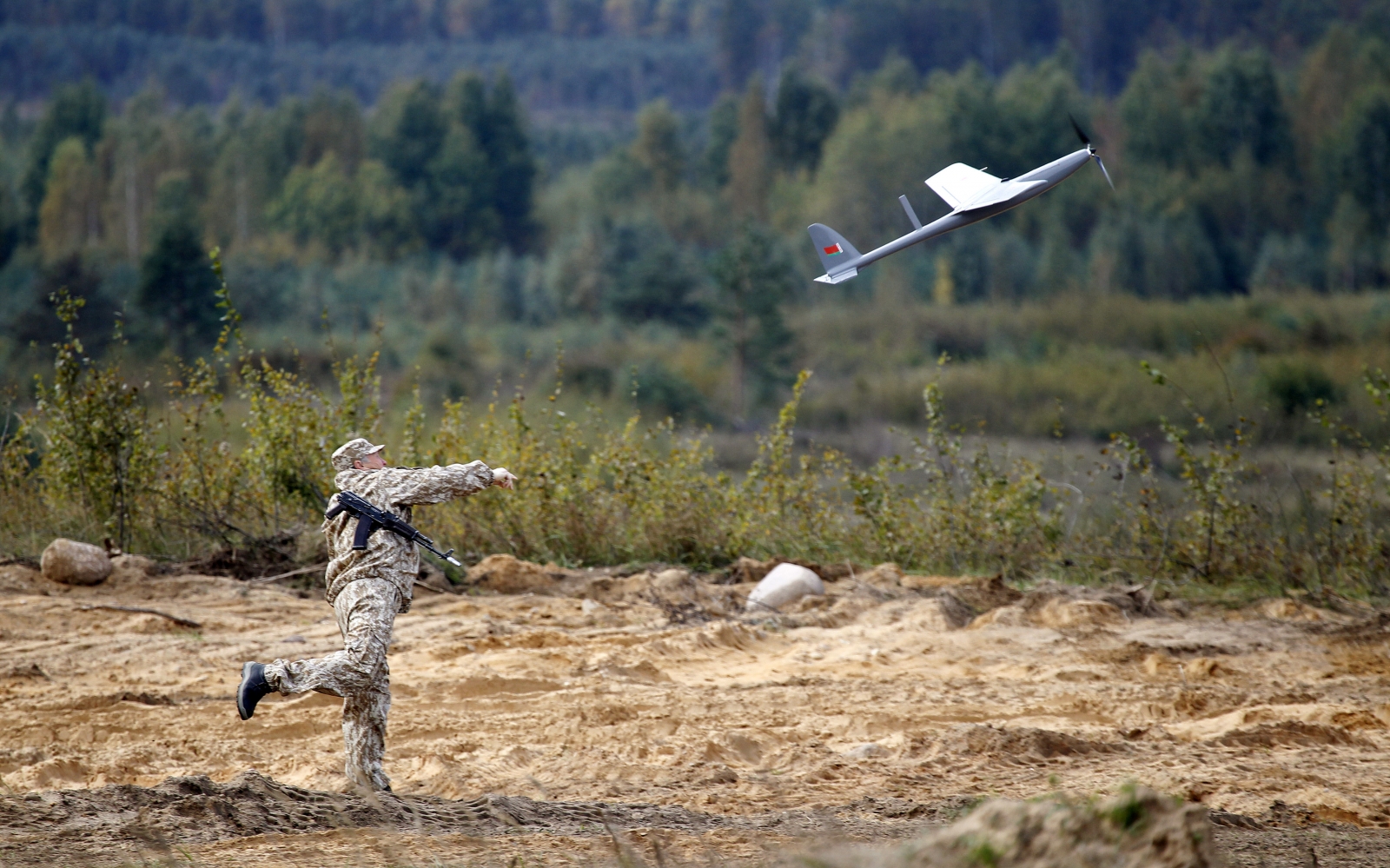
Russian drone entered Israeli territory but IDF could not shoot down UAV

Russian drone entered Israeli territory but IDF could not shoot down UAV

Russian drone Israel
Lebanese militant group Hezbollah earlier claimed its fighters had sent the drone.
A Russian drone is thought to have entered Israeli territory in what is considered a human error. It was initially believed that the unmanned aerial vehicle (UAV) belonged to Lebanese militant group Hezbollah.
The aircraft entered the Israeli airspace on 17 July from Syria and went as far as 4kms into Israel. The Israel Defence Forces (IDF) tried to shoot down the vehicle at least three times but were unsuccessful. The IDF acknowledged the incident but said they were not aware who sent it.
Two surface-to-air Patriot missiles and another air-to-air missile from a fighter jet were fired at the drone but missed their target. The UAV went back to Syria after the brief aerial encounter.
Though Hezbollah had initially claimed responsibility for the drone, it has now emerged that the UAV belonged to Russian forces, reports the Israeli daily Haaretz. The newspaper said Russian officials have admitted that the breach was caused by "human error". However, Israeli media outlets have also speculated that it is possible the Moscow's forces are checking Israel's defence capabilities by sending a drone.
Israeli Prime Minister Benjamin Netanyahu and Russian President Vladimir Putin have held a phone call over the matter in which the Russian leader clarified it was an accident, added the report.

Thursday, 4 August 2016

United States to Produce First New Nukes in Decades

United States to Produce First New Nukes in Decades


The United States is about to rebuild its arsenal of B61 nuclear bombs to a new standard, ensuring they stay reliable while adding new capabilities including a "dial-a-yield" capability. The process is so extensive some critics charge that the modified bombs are essentially a new weapon, a development that could restart the nuclear arms race.
The Pentagon has many types of nuclear weapons, but currently the only true "bomb"—dropped from an aircraft and delivered to target by free fall flight—is the B61. First produced in the late 1960s, the B61 series of bombs can be carried carried by a number of combat aircraft, including the B-52 Stratofortress, B-2A Spirit, F-15E Strike Eagle, and F-16 Fighting Falcon. The F-35A Joint Strike Fighter will also be cleared to carry the new version of the bomb.
Now the National Nuclear Security Agency, or NNSA, has cleared the B61-12 to enter its last phase of development before production. Production will involve taking older versions of the bomb and updating them to the B61-12 standard. Washington insists that the update is critical to ensure the bombs remain reliable into the future.
In addition to the reliability update, the B61-12 has several new features. It has a new set of bolt-on tail fins that increase the range at which the bomb can be released and still hit its target. This increases aircraft survivability while allowing the pilot to avoid close-in air defenses. The bomb also has a new inertial navigation system accurate to 30 meters, without using the constellation of GPS navigation satellites that might be shot down in wartime.
Finally and perhaps most importantly it has a "dial-a-yield" mechanism that allows the operator to choose the explosive power of the bomb. The bomb can be set to the equivalent of a mere 300 tons of TNT, 1.5 kilotons of TNT, 10 kilotons, or 50 kilotons. The Hiroshima bomb, for comparison, was about 16 kilotons.
The B61-12 program is estimated to run approximately $10 billion dollars, to produce between 400 and 500 bombs. That breaks down to approximately $28 million per bomb, which will make it the most expensive U.S. nuclear bomb project ever. At one point, with gold at $1,619 an ounce, observers of the program noted the 700 pound bomb cost "1.5 Times its Weight in Solid Gold."
Critics of the B61 modernization believe that introducing a new bomb into the military arsenal at this point could restart a nuclear arms race with Russia and even China. They also charge that the "dial-a-yield" capability and and low yields could encourage the Commander-in-Chief to use them instead of conventional weapons.
Supporters of the weapon believe that modernizing the U.S.'s nuclear bomb stockpile will put bad actors on notice that Washington is serious about its nuclear policy. The upgrade will also give the U.S. expanded options for using the weapons, trading explosive yield for accuracy. Using smaller bombs in a conflict could prevent escalation to using larger ones. But let's hope it doesn't come to that.

Monday, 18 July 2016

Kenya May Ink EU Trade Deal Alone as Brexit Spooks Neighbors

Kenya May Ink EU Trade Deal Alone as Brexit Spooks Neighbors

Kenya may abandon 10 years of negotiating a trade deal with the European Union as part of the regional East African Community bloc and go it alone, to avoid having duties of as much as 30 percent slapped on its exports from October.
A so-called Economic Partnership Agreement between Kenya, Uganda, Tanzania, Rwanda and Burundi and the EU is on hold after Tanzania’s government said two weeks ago it’s reluctant to sign any deal because of “recent developments affecting the bloc’s union.” The U.K. voted in a referendum on June 23 to withdraw from the bloc, ending a 40-year partnership. Uganda said last week it also wants to delay signing the deal.
“We would like to sign it together; the desire is that we sign it together,” Kenyan Foreign Secretary Amina Mohammed said in an interview in the capital, Nairobi, last week. “If we get to a stage where we can’t do that then we also have the right to make our own sovereign decisions.”
The negotiated EPA would give members of the EAC immediate duty-free quota-free access to the EU for all exports. The Brexit decision is complicating trade negotiations as ministers from around the world gather this week for the 14th United Nations Conference on Trade and Development in Nairobi, where the EPA accord has been scheduled to be signed.
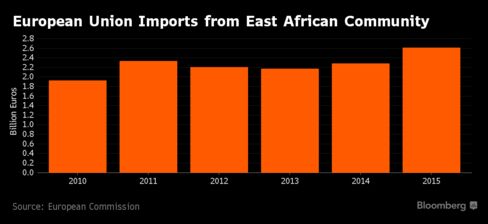
The EU imported goods worth 2.6 billion euros ($2.9 billion) from the EAC last year, data from the European Commission shows. Kenya exported 126 billion shillings ($1.2 billion) worth of goods to the EU in 2015, according to the national statistics office.
“Countries like Tanzania, which said it will postpone signing the agreement with the EU might want to wait and see what happens with Brexit,” Willemien Viljoen, a researcher at the Tralac Trade Law Centre in Stellenbosch, South Africa, said by phone. “That will affect other members of the East African Community.”
Brexit may curb capital flows into East Africa, hinder trade and investment, weaken exchange rates and damage economic stability in the region, central bank governors from the EAC trading bloc said in a statement to reporters in the Ugandan capital, Kampala, on July 14. Uganda wants to delay the signing the EPA to ensure the deal is signed collectively, Nairobi-based Business Daily newspaper reported on Friday, citing Julius Onen, permanent secretary for the nation’s trade ministry.

No Excuse

“There may be some dynamics about East Africa negotiating market access to Britain, but there is no sufficient reason to dither the EAC’s engagement with the EU on the basis of Brexit,” UNCTAD Secretary-General Mukhisa Kituyi said in an interview in Nairobi. “Brexit should not be an excuse.”
If the deal is not signed by Oct. 1, Kenya, as the only member of the East African Community not classified as a so-called least-developed country, could lose all its preferential access to the EU.
“The partners in the region realize there is a time pressure, so does the European Union,” Betty Maina, Kenya’s principal secretary for the East African Community, said in an interview on July 14. “So we are looking at all measures and engagements to ensure you don’t miss October 1.”
Kenyan farmers shipped produce such as carnations, green beans and avocados worth 90.4 billion shillings globally in 2015, according to the Kenya National Bureau of Statistics. Together with tea, fresh-produce exports generate the bulk of foreign-exchange earnings in East Africa’s biggest economy.
Flower exports by Kenya, which accounts for more than a third of the stems sold in Europe, may face taxes of as much as 20 percent unless the agreement is signed by Oct. 1, said Jane Ngige, chief executive officer of the Kenya Flower Council.
“We are trying to see how we will get out of the quagmire we are in,” Ngige said by phone.

Sunday, 17 July 2016

Hillary Clinton Leads Donald Trump in New National Poll

Hillary Clinton Leads Donald Trump in New National Poll


Presumptive Democratic presidential nominee Hillary Clinton is ahead of her GOP rival Donald Trump in a new national poll released on the eve of the Republican National Convention.
Clinton leads Trump by 46% to 41%, according to the Wall Street Journal/NBC News poll, which was released on Sunday. That five-point margin remains the same from aJournal/NBC News survey taken last month before the FBI criticized Clinton’s private email practices as “extremely careless” while she was secretary of state.
The poll also found that Clinton has a huge advantage among African-Americans with 84% supporting Clinton compared to 7% backing Trump. Clinton also had the support of voters between the ages of 18 and 29 by 55% to 32%, and women by 52% to 37%.
Trump is ahead among whites by 50% to 37%, as well as among men by 46% to 39%, according to the survey.
The poll interviewed 1,000 registered voters between July 9 and July 13. The margin of error is plus or minus 3.1%.

Brexit minister: Some EU migrants may have to leave UK

Brexit minister: Some EU migrants may have to leave UK

The minister in charge of negotiating Britain's exit from the European Union says some European Union citizens may not be allowed to stay after the U.K. leaves the bloc.
Brexit Secretary David Davis told the Mail on Sunday newspaper that he wants "a generous settlement for EU migrants here now and a generous settlement for British citizens in the EU."
He dismissed suggestions the estimated 3 million EU nationals in Britain might have to leave, but said if there is a surge in arrivals before the deadline, the government may have to set a cutoff date.
British Prime Minister Theresa May has been criticized for refusing to guarantee the right of EU citizens to remain. She says she needs to ensure that Britons living in EU countries get the same right.

Wednesday, 29 June 2016

S-400 technology helps Seoul blunt Pyongyang threat By Rakesh Krishnan Simha, Special to Russia Beyond the Headlines

S-400 technology helps Seoul blunt Pyongyang threat

By Rakesh Krishnan Simha, Special to Russia Beyond the Headlines
Advanced missile technology that went into Russia's deadly S-400 Triumf missile defense system is powering the South Korean ballistic and air defense missile programs.
Partly in response to North Korea's deployment of nuclear missiles and submarines, Seoul has beefed up its armaments industry with generous doses of Russian technology. Among the most critical projects are a submarine-launched ballistic missile and the M-SAM Cheolmae-2 medium- to long-range surface-to-air missile.
South Korea hopes to one-up the North, which is applying the technology of the Russian S-300 missile to its SLBMs. According to Lee Choon-geun, senior researcher at the Korean Institute of Science and Technology, South Korea "uses more stable technology" from the S-400, which is a generation ahead of the S-300.
The S-400 is a highly advanced missile with embedded cold-launching technology. Cold-launched missiles are critical for South Korea's brand new 3000-ton Jangbogo-III submarine. During a cold launch, the rocket engine fires after the missile reaches a certain altitude. This mechanism allows ballistic missiles to be fired from under water, thereby making it possible for the submarine to remain submerged. A high-ranking military official told Korea Joongang Daily the development of the new SLBM is expected to be completed by 2020.
The Daily reports the South Korean Navy's arsenal currently includes the submarine-launched cruise missile. However, as North Korea's efforts to develop SLBM technology have almost reached completion, the need within the South Korean military to initiate a response has become urgent.
"Although the SLBM may lack the accuracy of the SLCM, which is equipped with a guidance system, its velocity and destructive capability are significantly greater," says Kim Hyeok-soo, former rear admiral and the first commander of a South Korean submarine flotilla. "The deployment of the speedy and stealthy SLBM will allow the South Korean Navy to deliver a blow to North Korea before the situation even escalates to emergency levels."
Air defense of the South
Meanwhile, the M-SAM is being jointly developed by Samsung Group and French electronics defense contractor Thales Group. Richard Weitz, director of the Center for Political-Military Analysis at the Hudson Institute, writes: "The M-SAM will use S-400 missile technology provided from the Almaz Antey Joint Stock Co., including proprietary information from the S-400's multifunction X-band radar. LG Corp.'s missiles' guidance systems are expected to also use Russian design elements."
The M-SAM Cheolmae-2 is designed to engage both ballistic missiles and aircraft. If the South Koreans are able to achieve anything close to Russia's S-400, they will have a fearsome weapon with which to take on the North's armory of ballistic missiles.
The S-400 has a tracking range of 600 km and the ability to hit targets 400 km away at a blistering speed of 17,000 km an hour – faster than any existing aircraft. First deployed by Russia in 2010, each S-400 battalion has eight launchers, a control center, radar and 16 missiles available as reloads.
"Given its extremely long range and effective electronic warfare capabilities, the S-400 is a game-changing system that challenges current military capabilities at the operational level of war," Paul Giarra, president, Global Strategies and Transformation, told Defense News.
According to Air Power Australia, "The S-300P/S-400 family of surface-to-air missile systems is without doubt the most capable SAM system in widespread use in the Asia Pacific region." It adds: "While the S-300P/S-400 series is often labeled 'Russia's Patriot,' the system in many key respects is more capable than the U.S. Patriot series, and in later variants offers mobility performance and thus survivability much better than that of the Patriot."
For decades, South Koreans have lived in fear of North Korea's missile threats. The new generation missiles will finally allow South Korea to close that window of vulnerability.
Changing Russia-South Korea defense partnership
As a key U.S. ally and loyal customer of American weapons, South Korea is an unlikely buyer of Russian weapons. In fact, Seoul's defense trade with Moscow grew in an unlikely way. In 1991, after the Cold War ended, South Korea extended $1 billion in cash loans and a $470 million commodities loan as a reward for Moscow's recognition of South Korea. However, the Soviet Union went under the same year.
Unable to repay the loans in cash, Russia began supplying what it had in plenty – military equipment such as T-90 tanks, infantry combat vehicles and helicopters. The first two arms-for-debt deals – all known as Brown Bear – were inked in 1995 and 2003.
However, Seoul did not want to keep importing ready-made weapons platforms, even if the South Korean military was thrilled with the high-octane Russian military gear. There were two reasons for this. One, since Seoul is closely integrated with America's military ecosystem, Russian weapons are not easily integrated. This is, of course, an old American ploy to edge out rivals and increase the market share for its own weapons. At any rate, the South Koreans decided to stop wholesale purchases of Russian weapons.
Secondly, the South Koreans became more ambitious. They wanted to build a world class military industrial complex in step with their dominance in a number of commercial sectors. The government's Defense Reform 2020 initiative is aimed at developing the country's indigenous capabilities via defense R&D. The transfer of cutting-edge S-400 technology is part of this plan.
Seung-Ho Joo and Tae-Hwan Kwak write in their book Korea in the 21st Century: "South Korea may find economic benefits in military cooperation with Russia. Seoul and Moscow can jointly develop advanced technology and high-tech weapons and sell them in the world market. The relationship between the two countries may be mutually complementary: Russia has two advantages in basic sciences and advanced technologies, while South Korea has strengths in marketing skills and capital."
The S-400 isn't cheap – it costs around $500 million per battalion. That's why only countries with deep pockets like China and India (which is negotiating a deal) will be fielding this weapon. But to the credit of the South Koreans, they beat both the Chinese and the Indians to this prized weapon by more than a decade.
Flip side of tech transfers
To be sure, Russia could face some hiccups over the transfer of such leading edge weapons. South Korea's close alliance with the United States means there is a chance of sensitive Russian technology ending up in America's hands. One of the reasons Russia is not unduly worry about U.S. stealth fighters such as the F-22 and F-25 is that the Russian air defense system is considered impregnable to these aircraft. The S-400 is one of those wonder weapons in the Russian arsenal that have neutralized the threat from fifth-generation fighters.
However, if South Korea passes on the secrets of the S-400 to the United States, it would compromise Russian – and Chinese – air defense to some extent. For instance, the 1976 flight of a Soviet defector in the top secret MiG-25 fighter forced Russia to produce new radar and missile systems for the aircraft at considerable cost.
Secondly, if South Korea integrates the S-400-based M-SAM into the American missile defense system, Russia could potentially have to face off its own missiles in any future conflict with the United States.
But with the next generation S-500 missiles coming online, Russia will not lose too much sleep over any potential leak of secrets. For, once you export something, it's a given that your competitors will get their hands on it sooner or later.
This article originally appeared at Russia Beyond the Headlines.

Wednesday, 22 June 2016

Chief of US Naval Operations explains why he's not afraid of China's 'carrier killer' missile

Chief of US Naval Operations explains why he's not afraid of China's 'carrier killer' missile

Speaking at a Center for a New American Security conference on Monday, the US Chief of Naval Operations, Adm. John Richardson, explained why China's DF-21D "carrier killer" antiship ballistic missile isn't all it's cracked up to be.
The DF-21D, an indigenously created, precision-guided missile capable of sinking a US aircraft carrier with a single shot, has a phenomenal range of up to 810 nautical miles, while US carriers' longest-range missiles can travel only about 550 miles away.
Therefore, on paper, the Chinese can deny aircraft carriers the luxury of wading off of their shores and forcing them to operate outside of their effective range.
But Richardson contested that notion.
"I think there is this long-range precision-strike capability, certainly," Richardson acknowledged. But "A2/AD [anti-access/area-denial] is sort of an aspiration. In actual execution, it's much more difficult."
China's intelligence, surveillance, and reconnaissance capabilities (ISR), bolstered by a massive modernization push and advanced radar installations on the reclaimed islands in the South China Sea, have theoretically given them the ability to project power for hundreds of miles.
"The combination of ubiquitous ISR, long-range precision-strike weapons takes that to another level and demands a response," said Richardson, adding that China's extension into the Pacific created a "suite of capabilities" that were of "pressing concern."
ut the US Navy won't be defeated or deterred by figures on paper.
Richardson said:
"In the cleanest form, the uninterrupted, frictionless plane, you have the ability to sense a target much more capably and quickly around the world, you've got the ability, then, to transmit that information back to a weapon system that can reach out at a fairly long range and it is precision-guided ... You're talking about hundreds of miles now, so that raises a challenge."
"Our response would be to inject a lot of friction into that system at every step of the way [and] look to make that much more difficult," he continued.
Richardson was clear that China's purported capabilities were only speculations.
"What you see often is a display of 'Here's this launcher, here's a circle with a radius of 700 miles, and it's solid-color black inside' ... And that's just not the reality of the situation," he said.
"You've got this highly maneuverable force that has a suite of capabilities that the force can bring to bear to inject uncertainty," Richardson continued.
Richardson also went on to address the dual aircraft-carrier deployments in the Pacific and theMediterranean, saying that the deployments afforded a rare opportunity for "high-end war fighting and training," as carrier groups rarely get to train with each other in realistic, not just theoretical, situations.